
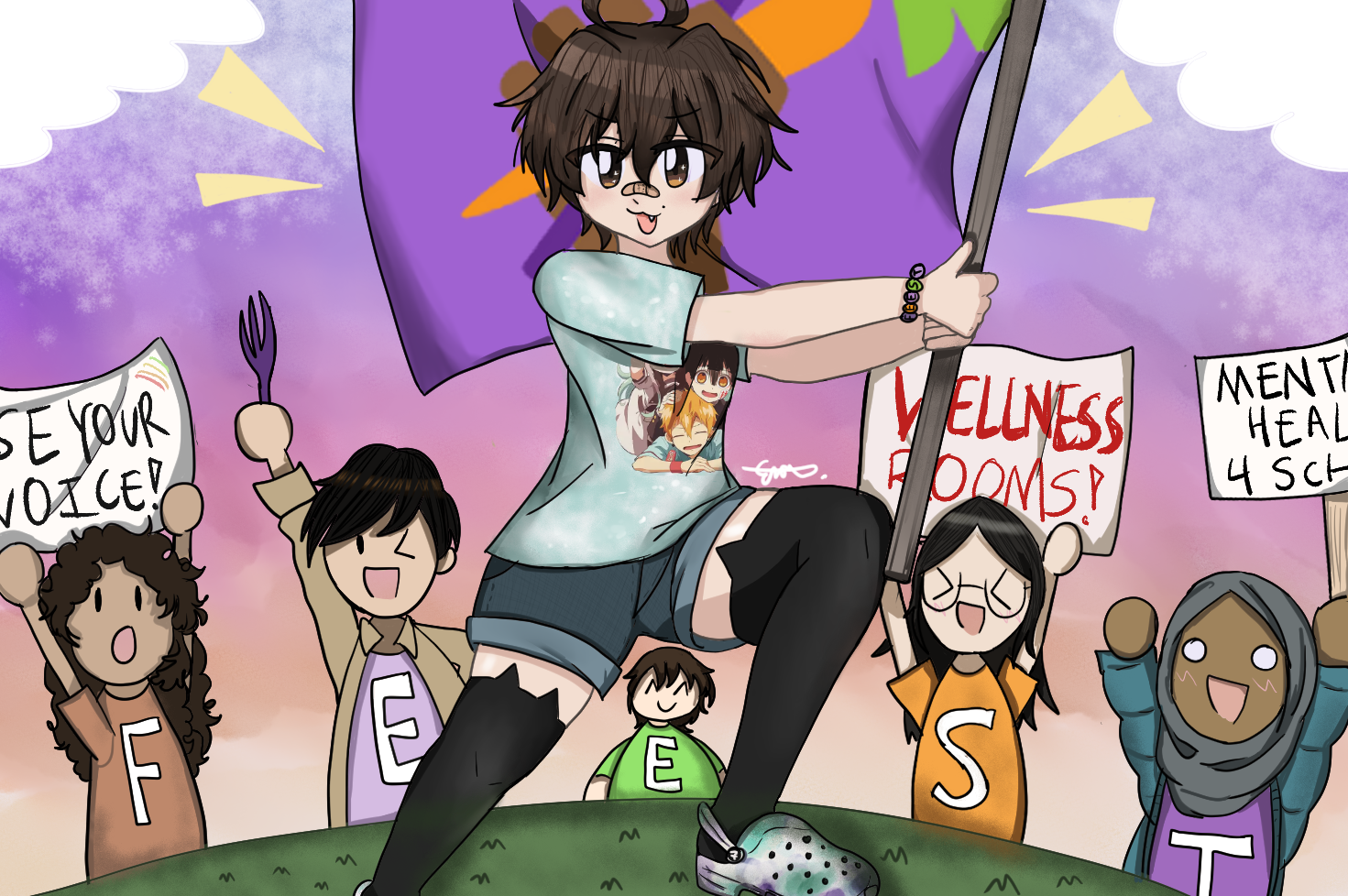
The image is a dynamic illustration created by FEEST Student Organizer Eva, of fellow youth rallying for change, with a central figure holding a flag and others holding signs advocating for mental health and student power.
Our Campaign for Wellness Rooms: A Student Activist Story
by FEEST Student Organizers: Elkram, Eva, Emily, Huda, & Nawaal
Editor’s Note:
This article was written in 2024 by FEEST Student Organizers in collaboration with South Seattle Emerald. We are honored to share it here so their voices, experiences, and leadership continue to reach our community, and to uplift the story of their organizing for mental health and Wellness Rooms.
A Day in the Life of a Student Organizer at FEEST:
“It was finally the day! October 25th, 2023 – the official launch of the Chief Sealth Campaign Kickoff. At first, at least one of us would admit, we were uneasy about participating and how it would go. Reality was kicking in. Not only would I be asking immature teenagers to fill out this unfamiliar survey, but I’d be serving them a pastry of their choice, handing it to them, and making EYE CONTACT! I may be more socially awkward than the average teen, especially after all of those years of isolation from the pandemic, but truly, it was work to get out of my comfort zone, and it paid off. We got hundreds of respondents from five King County Schools about their mental health needs, and used that data to create a plan to address them.”
The above was a snapshot from one of our very own Student Organizers at the beginning of our mental health campaign. You might think this is where our story began, but the creation of the survey was built on YEARS of preparation!
In the fall of 2021, FEEST (Food Empowerment Education and Sustainability Team) was rooted in youth power, strengthening our communities through organizing for transformative change in schools despite the potentially isolating change to online learning. This intention blossomed into a multi-year campaign to address student mental health in the Seattle Public Schools (SPS) and Highline School Districts (HSD) — adjacent districts that share a border where West Seattle meets White Center. Because we FEEST organizers are students in these districts, we understand what is needed to make them better for us and for our peers. This is our story, told by us.
Our Story
Our story starts 16 years ago, in 2008, with a community of people gathering at the Youngstown Cultural Arts Center, hoping to create a space where youth could have free, culturally relevant meals. For nearly two decades, FEEST has been organizing alongside young people to challenge inequitable systems and reimagine what’s possible in their schools and communities. Rooted in the fight for food justice, our work has expanded in the last few years to meet the priorities students have named–most urgently, mental health.
Before the COVID-19 pandemic, our work centered around student-led dinners: an afterschool space where young people built community, cooked and shared meals, and discussed changes they wanted to see in their schools while working on ways to make those changes actually happen. For the sake of safety, and the safety of others around us, we paused in-person gatherings during lockdown and transitioned to meeting online, which caused us to pause our afterschool dinner program. In that shift, we identified new pressing issues—mental health, school safety, restorative justice, and holistic wellness—as priorities we were ready to organize around.
Even while organizing online, we strategized, built relationships with decision-makers, and worked to ensure our voices were heard. When we returned to campus in Fall 2021, the urgency of these issues was impossible to ignore, even across two school districts. It was clear that the next campaign needed to focus on one of the most pressing struggles students were facing daily: mental health.
Campaigning for Mental Health
We arrived at this conclusion after numerous one-on-one listening sessions where we asked our peers from Franklin High School, Rainier Beach High School, Chief Sealth International High School, Evergreen High School, and Tyee High School which issues they would like us to organize around. These schools are all 85-95% students of color. Compared to other potential issues like improving school lunch and restorative justice, mental health received an overwhelming amount of support. This need was further solidified with events like the November 2022 shooting at Ingraham High School, and multiple school shelter-in-place lockdowns during the transition back to in-person school. Though we knew everyone’s voices couldn’t be heard, we knew we could help our classmate’s voices be amplified.
We were firmly decided and started the information-gathering phase. We spoke with Aaron Lyon and Eric Bruns of the University of Washington School Mental Health Assessment Research and Training (SMART) Center about the importance of Social Emotional Learning (SEL). We also participated in multiple Highline School District and Seattle Public Schools board meetings, and HSD board directors Aaron Garcia and Carrie Howell, as well as SPS board directors Brandon Hersey, Liza Rankin, and Chandra Hampson, attended some of our regular meetings. These sessions with thought leaders and local decision-makers helped us develop our initial campaign goals! We’re thankful because we learned crucial information about how to move forward during the next school year.
Within our second year of our campaign, which was during the 2022-2023 school year, we shifted from information gathering to conducting outreach and specifying our goals. During this time we even started having in-person meetings again! We also held our own online events such as the “Change Takes Action,” a panel we hosted with our fellow students featuring mental experts and school staff, where we got to learn from each other and narrow down what was possible. One of our very own Student Organizers, Amelie, even facilitated a radio show, “Earth Deserves More than a Day,” with our friends at Front & Centered, that allowed us to connect with more students from across the city and meet around the issues that were most important to us. We created a mental health curriculum for the Seattle Educators Association (SEA) Teachers Union Conference and shared our learnings about why mental health is important to the holistic wellness of our schools.
Throughout the year, we built relationships, showed up to support other youth-led organizations, and were able to gain support from students, school staff, therapists, and decision-makers. We ended the year with a plan to launch a survey in the Fall of 2023 because we were planning a multi-school campaign kickoff to raise awareness about mental health.
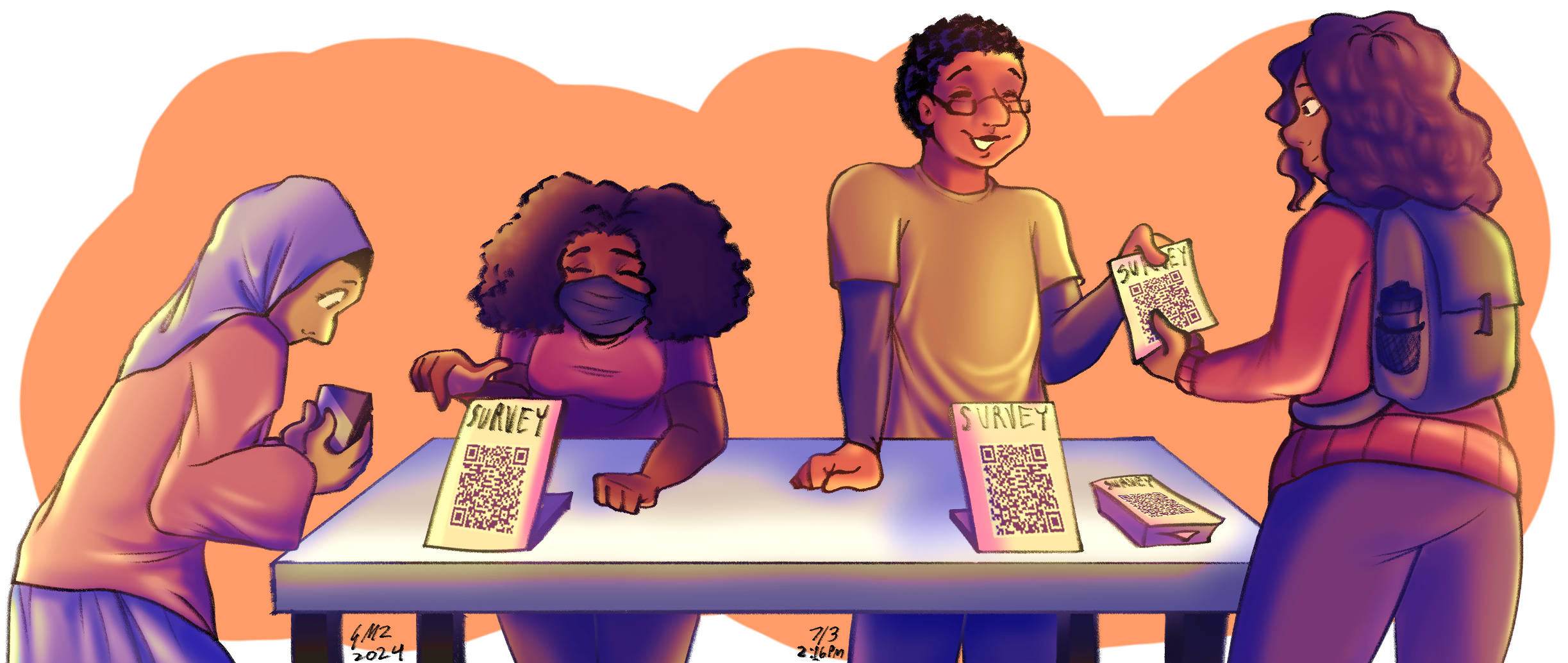
The image is of a warm and comfy illustration by Elyssa, a recent graduate of Evergreen High School in White Center. The art showcases a group of students engaging in a school survey campaign, handing out QR codes, and engaging peers in conversation.
What Students Need on Campus
The youth at Franklin, Chief Sealth, Rainier Beach, Tyee, and Evergreen spoke to us clearly through the survey. We studied the data we collected from our peers, and created “What Students Need on Campus,” a multi-page infographic for our fellow students (and adult supporters) to digest our learnings in an accessible way. They needed more therapists with similar lived experiences to the student population, more opportunities for SEL, and Wellness Rooms. Although we hoped to address all three campaign goals, we believed it was best to prioritize a single goal — especially since there are multiple ways to tackle a problem, and we were tackling it in two different school districts.
So we held two all-district FEEST meetings to find the one goal that would benefit students most. In those meetings, we analyzed the survey results and agreed to focus on the most realistic and the most requested goal: Wellness Rooms. These spaces are meant to be comfortable, inviting spaces where students can visit to reflect and practice regulating their emotions, or even seek support from trusted adults. We came to a consensus that this might help reduce stress and behavioral issues in our schools.
In HSD, the ball got rolling quickly after conversations with former Board Director Garcia, Social Emotional Learning Director Melissa Pointer, Community Partnership Manager Nikki Fogerty, and then Assistant Superintendent Kisa Hendrickson. Student Organizers spoke at a school board meeting, encouraging decision makers to find funding for the first Wellness Rooms in HSD! HSD also requested a partnership with FEEST and for FEEST student activists to contribute to the Wellness Room design! In SPS, however, it was a different story…
Wellness Room Campaign Launches in SPS, Sparking Deeper Reflection
While our peers in HSD were seeing movement in their organizing to get Wellness Rooms on campus, SPS Organizers got to work to facilitate and create an open meeting with a bunch of students at our schools, to discuss the Wellness Room idea, and what they would want out of it. This included what it would look like visually, and how it could potentially meet some of their mental health needs.
At one of our schools in SPS, we were able to organize a meeting with a staff member who worked directly on mental health with students. FEEST Student Organizers gathered on a Thursday afternoon to wait for them. We hoped this would help us get closer to having a Wellness Room at a South End school. After introducing ourselves and asking them questions about themself, we asked what they thought about the school having a Wellness Room. They expressed concern about how the room might not be used correctly, and they thought it might be taken advantage of.
We hadn’t anticipated this response, but we asked them for suggestions and their response left us with the impression that they didn’t support having a Wellness Room at all, saying students needed to focus on their studies. They shared concerns that the Wellness Room might become a distraction. We understood their perspective and concerns and took their feedback, but still felt strongly that a Wellness Room could have a positive effect on students.
Then the staff member showed us the room where they worked. It was a small room that looked like a closet from the outside. Inside, there was calming light and comfortable seating — making it feel a little like what we imagined a Wellness Room would look like. When we commented about how we could imagine a space like this benefitting student mental health in the school, they didn’t seem excited about the idea. They explained to us that the room is intended for students facing difficulties, not for those looking to relax. They emphasized the need for it to remain a serious room, for students who are being disruptive, are really behind in their work, or for students to cool down after getting into a fight.
We took some time to reflect on the discussion. We all felt that it was wrong that the room is used in the aftermath of students having a breakdown, getting in trouble, or when they were involved in a fight. We still felt Wellness Rooms should be implemented because they could help students before things escalate. Mental health awareness and support goes hand in hand with Restorative Justice!
Around the same time, our Franklin FEEST fam met up with Principal Weiss for an informal discussion on the possibility of Wellness Rooms. We walked into the main office and were greeted by his secretary, Ms. JJ, and before we knew it we were walking into his office. About 10 of us were in the room, along with FEEST staff; we spread out and sat in chairs or on the floor, detailing our campaign idea and its backstory.
To our surprise, he agreed with us! He had actually been informally surveying students in the hallways and bathrooms about what they’d like to see change at Franklin — in particular, what would help them not feel the need to hang around bathrooms or be outside of classrooms.
Principal Weiss did have some similar concerns to the mental health staff member at one of our other schools about how it would be run and asked questions about what we’re looking to have in these Wellness Rooms, what students will do in these rooms, and who will staff them. We didn’t have answers to all of his questions, initially, but we created a follow-up survey for students and staff to help fill in the blanks. Since then, Franklin Student Organizers have distributed surveys, while Principal Weiss worked on securing the rooms and brainstorming funding for furniture and other things we want to see in those Wellness Rooms.
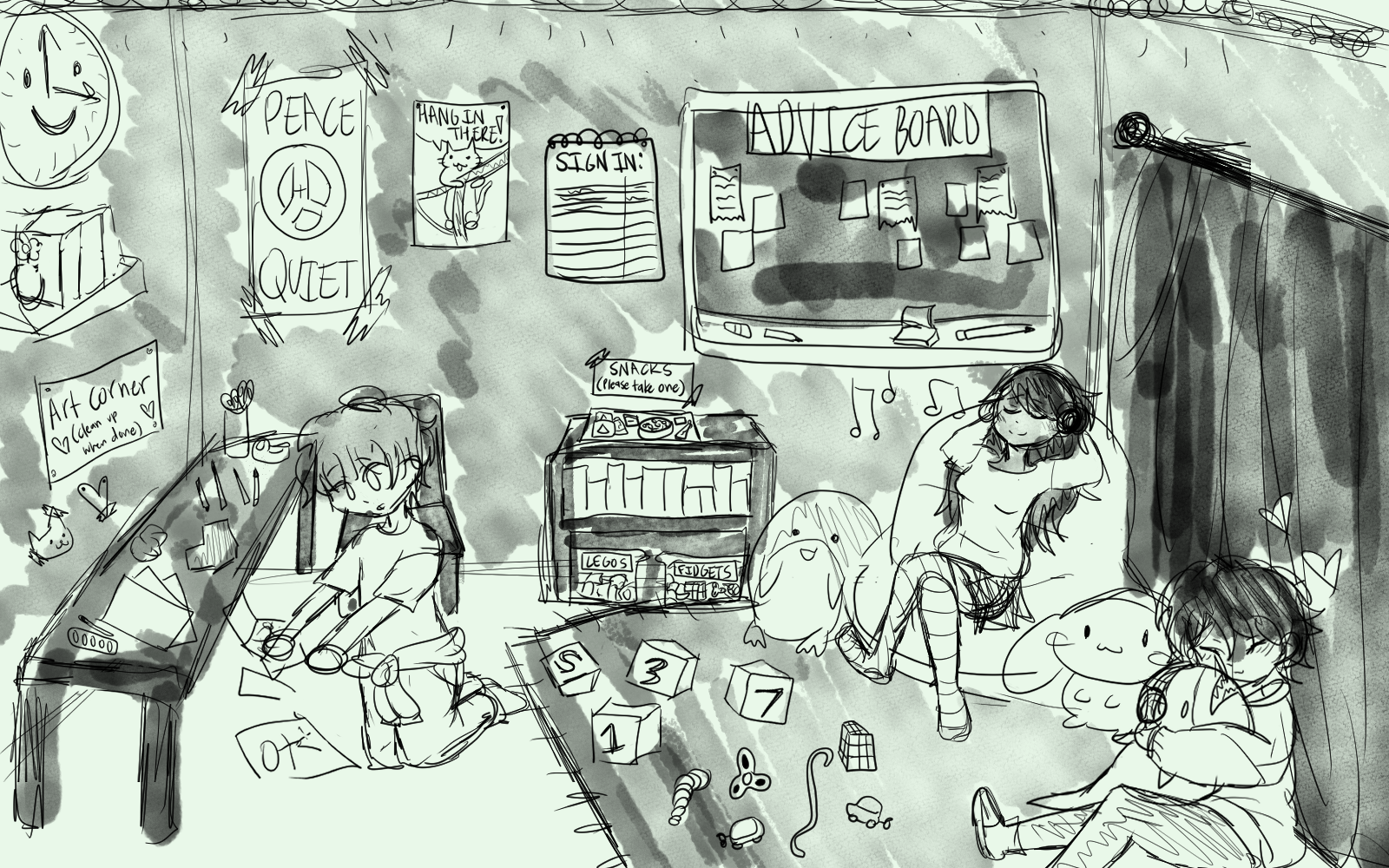
This image is of a black-and-white sketch of a calming wellness room, designed as a peaceful space for students to rest, reflect, and reset, created by FEEST Student Organizer Eva!
Where We’re At
While we continued to organize, during the 2023-2024 school year we continued to see just how deep some issues ran in our schools. Whether it was food running out during lunch at Tyee and Evergreen, bathrooms being locked and inaccessible due to vaping concerns, or the lack of gender-neutral restrooms, students continued to face challenges that extended far beyond school lunch, and all of these issues impacted our mental health.
In HSD, FEEST has continued its work building youth power and getting more youth voices in decision-maker spaces. We wanted to bring a deep focus on what is happening for students on the ground to district leadership, and be considered and consulted during the decision-making process.
While we testified about mental health at school board meetings, we were disappointed to hear inappropriate remarks about trans people from adults who were in that space. Our vision is for all students to feel welcome at, and to be the central focus of school board meetings. This deepened our belief that there is a lack of accessibility to decision-makers, and a need for more spaces where youth and decision-makers can collaborate, we decided to request another meeting with decision-makers directly. It is very brave for students to show up to board meetings and speak their truth, because school board meetings can be adult-centered.
In a recent meeting with Superintendent Duran and other HSD leaders, we communicated the need for a safe space for all youth of color to voice their needs, and that we would be continuing to take action towards mental health support for students. We also requested that FEEST students join his advisory team, and received information about how that would be possible.
Meanwhile, in SPS, we continued to focus on the successful implementation of Wellness Rooms and have met with South End leaders, like Tammy Morales, who promised to try and secure more funding at the city level for student mental health, while she was on the city council.
Currently, there are 11 Wellness Rooms in HSD! What started as us organizing for Wellness Rooms at Tyee and Evergreen has grown to benefit so many more students in our district. In SPS, there are plans for one in the new Rainier Beach High School building, at Franklin High School, and Chief Sealth International High School. We’re super excited to continue building this momentum and bringing this important conversation about mental health, food justice, and student well-being to the forefront!
FEEST just celebrated our Sweet 16 as an organization. It’s amazing that FEEST has been working on making real change in our community since the year most of us were born! Our history goes back to us breaking bread and building relationships with each other around the lunch table. Those youth wanted what we still want now: a better world for all of us. We want students like ourselves to thrive at school, and not worry about going hungry, being discriminated against, or having our mental health care needs brushed to the side. As Student Organizers, we will continue to fight and push for changes to be made and to bring the mic to uplift the voices that are ignored the most.
Big shoutout to the FEEST staff for always having our backs while we built this campaign from the ground up! It’s wild to think that what started 16 years ago as a fight for fresh, free, and culturally relevant school lunches has grown into something even bigger—a space where youth are organizing to get the mental health support we need and fight for the holistic wellness of our peers and school communities. Through it all, FEEST has stayed right there with us, following our lead as we push for real change.
A huge thank you to the South Seattle Emerald staff for supporting us in telling this story. Y’all held us down, led sessions with us, shared knowledge on creative writing, journalism, and storytelling, and that helped us shape our voices and make sure our organizing and experiences are seen and heard!
Want to know how you can support us and join in on the fight?
We need your help to pass the torch to the next generation of leaders. Young people need our adult allies to show up and support our organizing, now more than ever! Our call to action to everyone reading this is to figure out a way to help the youth in your communities. If you don’t know where to start, come tap in with FEEST and find out! Check out our website or Instagram, or sign up for our newsletter to hear updates on how our campaigns are going and how you can stand in solidarity with us!
Show FEEST some love!
Youth are in the lead at FEEST because we know that change is not effective unless those most impacted by health inequities are the decision makers. Support youth leadership by donating today, OR sign up for our newsletter to get the latest from FEEST!