
My Voice Does Matter: Susie on Mental Health, School Food, and Speaking Up
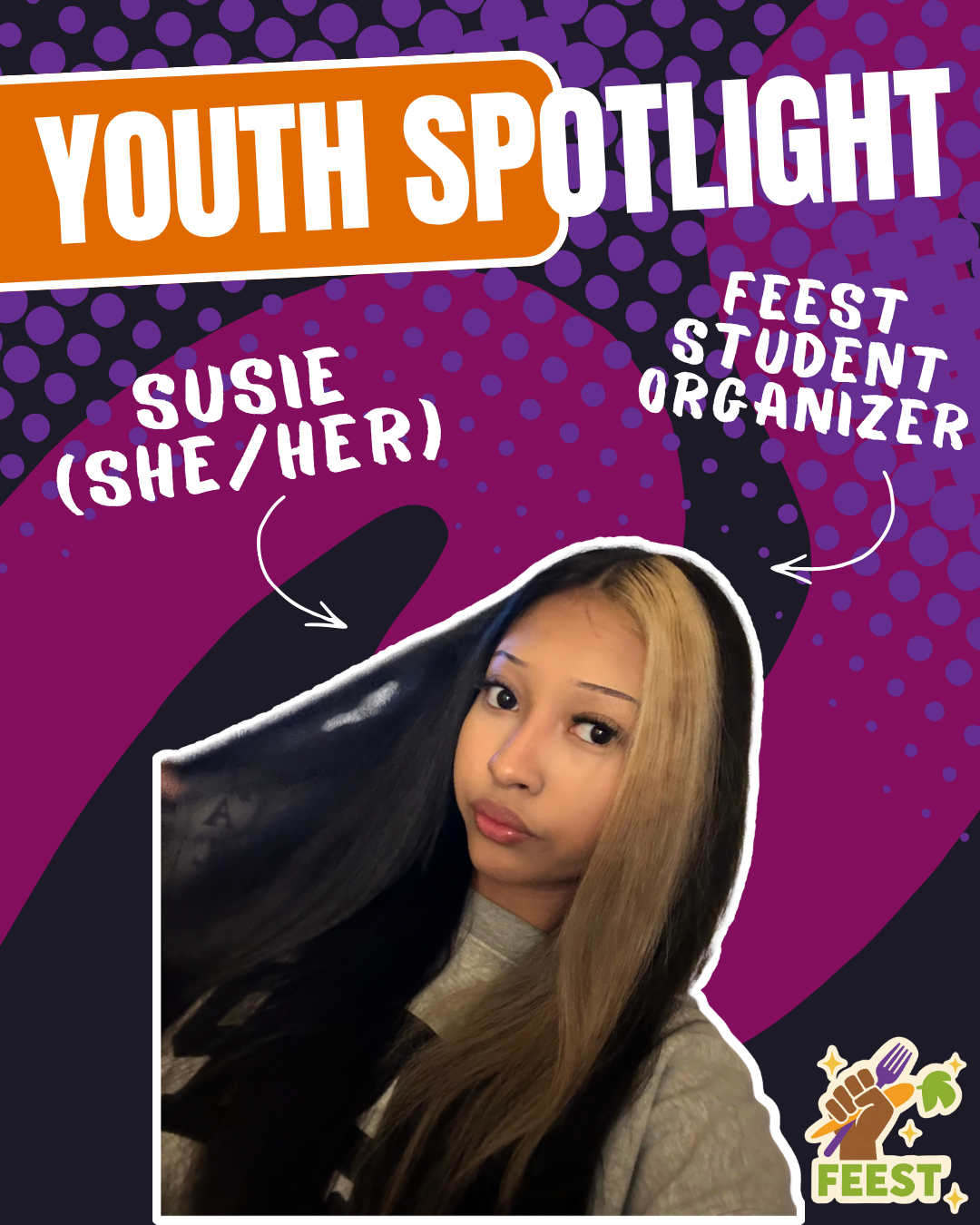
Today we’re featuring Susie (she/her), a rising junior, first-year FEEST Student Organizer, and cheerleader who takes to the air as a flyer. She talks about finding her voice during FEEST’s Summer Camp, advocating for mental health resources, and making sure students have nourishing food that fills them up. Along the way, Susie shares her hopes for her community, her love for animals, and her dream of doing work that helps future generations.
Dev: Thanks so much for chatting with me, Susie! To start, can you share your name, pronouns, grade, and a fun fact about yourself?
Susie: My name is Susie. My pronouns are she/her, and I’m an upcoming junior. I’m a cheerleader, and I’m a flyer, so they toss me in the air. My favorite color is pink, and I really like the show Gilmore Girls.
Dev: Okay, Gilmore Girls! We love to see it. What made you want to join FEEST, and what are you most excited about so far?
Susie: I’m really excited to meet new students, learn from their experiences, and get to relate to people. What was important to me about joining FEEST was getting to hear students’ voices, create new opportunities, and give positive energy back to the school and community. I want to help build confidence, develop leadership skills, and speak up about issues that are affecting us nowadays. I care about students’ mental health and well-being.
Dev: I love that answer. You’re naming what FEEST is about: relationships, student voice, and change together. What is something you care deeply about changing in your school or community?
Susie: I care about making sure all students feel heard, supported, and included. I want to help create a school environment where students have access to mental health resources and feel comfortable speaking up about their needs.
I feel like people around my age can be really closed off about their mental health and emotions. I want them to have resources.
Dev: That makes so much sense. Does that passion come from experiences in your own life?
Susie: Yeah, I’ve learned from experience myself, and I’ve seen it in my family and with my little sister especially. I just want to help in any type of way, and I feel like FEEST will give me the opportunity to do that.
Dev: Thank you for sharing that! I relate deeply to wanting the people around you to have support and recognize what they’re going through. If someone asked why they should support FEEST and students like you, what would you tell them?
Susie: I would tell them that FEEST gives students a chance to lead, learn, and create positive changes in their schools. Supporting FEEST means investing in young people and helping them build a better future for the community as well.
Dev: Period! You recently attended your first FEEST Summer Camp. What stood out to you and made you want to stay involved?
Susie: One moment that stood out to me was how we got to speak up and share ideas during our sessions. We were sitting at the tables together, having discussions, and getting to reflect toward the end.
It made me realize that my voice does matter and that I can help create positive changes in my school. I also realized that other students’ voices matter. I think that’s an amazing thing FEEST brings. I get to hear other people’s opinions and learn from the people helping guide our discussions.
Dev: I love that this stood out to you! Summer Camp is a long week, and we cover so much, but one of the most important parts is making space for students to speak for themselves. Your voice matters, and I’m glad that came through in your first FEEST experience.
Let’s talk more about mental health. What do students need to feel supported, safe, and well at school?
Susie: Students need access to mental health resources, trusted adults, and a safe environment where they can express their feelings, feel respected, and feel listened to. FEEST has helped me understand the importance of advocating for mental health and speaking up about students’ needs.
I’ve also heard people talk about bringing service animals to support students during therapy or wellness days. I think that would be such a good opportunity for students. Animals are really good therapy support. You don’t even have to talk to them. They just have to be there for you. I have three dogs and one cat. I feel like they understand and feel our emotions.
Dev: Three dogs and one cat? You have a whole support team at home! I love that. People sometimes forget how much our nonhuman community can support our mental health. Do you see yourself speaking publicly about this issue this year?
Susie: Yes, I do see myself speaking up about mental health! School presentations helped prepare me to speak, and sometimes I get nervous, but for this topic, I feel more confident.
I want to get the word out about how mental health impacts younger people and how it can continue from generation to generation. I feel like it’s good to start now instead of later.
Dev: I agree completely. Starting now matters, especially because students are already living with these issues every day. Let’s shift to food justice. When you think about food at school, what do students deserve?
Susie: I feel like we could use more healthy, nutritious food. We do get fruit, but I’m talking about food that fills us up.
I think having a food pantry would be amazing too. The food could be more culturally themed so students and teenagers would gravitate toward it. Regardless of someone’s background, what matters is that their stomach is full that day. Some days, neither of the two options is something I want, so I end up not eating that day.
We don’t get snacks either. We have to ask the counselors, but some students might not be talkative. They might feel embarrassed to ask.
Dev: That is so important. A resource is harder to access when students have to explain themselves or work up the courage to ask for it. Food should be available without embarrassment. Building on that, how can not having enough food affect students during the rest of their day?
Susie: I come from a low-income family background. Some students also have sports after school. If they don’t eat that day, what if they faint? Then it becomes a whole big problem.
If schools saw how hunger can mentally and physically impact students, I feel like they would understand how much it affects us.
Schools could also bring back after-school meals. We had them in middle school. Sometimes, when I didn’t eat during the day, the after-school meals had a better variety. You could take them home, and you didn’t have to feel hungry during practice.
I feel like that would be another good opportunity for FEEST to work on in the food justice area.
Dev: That’s such a good idea! I remember after-school snacks too, and it really shows how much students lose when those supports disappear.
Food justice and mental health are deeply connected. When students are hungry, it affects everything from focus to emotions to performance in school and sports.
Before we wrap up, I’d love to hear about your dreams. What are you excited about for your future?
Susie: My dream may sound crazy, but I want to get my degree in everything. I want to be everything and do a little bit of everything.
I feel like that could show me different things I wouldn’t even know about otherwise. Maybe I could help or save somebody’s life one day. I want to do things that impact young adults and young people, so I can show them, “This is what I’m doing,” and then they can carry it on and make the world better.
The world is pretty cruel, so I just want to do something good.
Dev: Wanting to learn, explore, and help people is a beautiful dream. The world can be cruel, and I really appreciate that your response is to try to do something good.
Is there anything you want to say directly to our community?
Susie: Don’t judge anybody by their background or income because that really does impact people.
People might think someone isn’t good enough for school because they don’t have enough money to buy certain things. I feel like it’s better not to judge because it can impact people to the point where it leads to bullying.
I’ve learned that from past experiences and from seeing it with my sister too. Just don’t judge people, honestly.
Dev: Beautifully said. I couldn’t agree more. Thank you so much for sharing your perspective, Susie. I’m so happy we got to talk, and I can’t wait to see what you do during your first year with FEEST!
For Susie, student voice, mental health, and food access are all part of creating schools where young people can feel supported and cared for. Her ideas are grounded in what students experience every day: trying to learn while hungry, feeling nervous about asking an adult for help, or carrying emotions without having a safe place to express them.
Susie is already envisioning ways schools can show up differently, from culturally relevant meals and after-school food to trusted adults, therapy animals, and accessible mental health resources. We’re grateful for her honesty, her care for other young people, and her willingness to speak up. We’re excited to watch Susie continue building confidence, sharing her voice, and doing something good for her community.

KEEP YOUTH VOICES IN ACTION
Help FEEST raise $40,000 by December 31st! When you make a gift to FEEST, you are helping Student Organizers just like Malick, who are fighting for food and mental health justice inside their schools.
Show FEEST some love!
Youth are in the lead at FEEST because we know that change is not effective unless those most impacted by health inequities are the decision makers. Support youth leadership by donating today, OR sign up for our newsletter to get the latest from FEEST!