
Malick’s Three A’s for Creating Change
Today we’re featuring Malick (he/him), a new FEEST Student Organizer and incoming ASB president at his high school. In this conversation, Malick shares what brought him to FEEST, why schools are important parts of their communities, and how meaningful student input can improve everything from school lunch to student wellness.
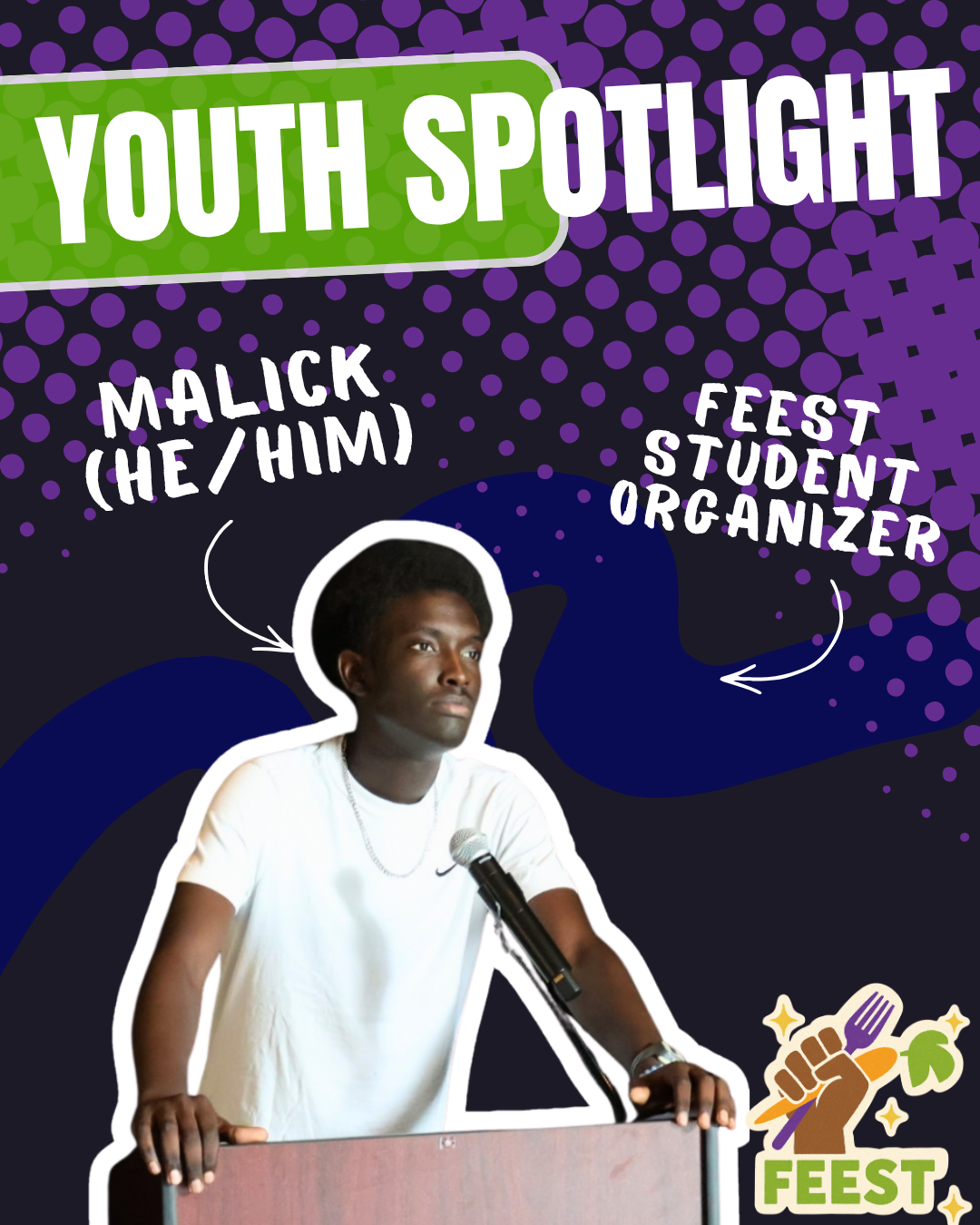
Read along, and learn more about Malick’s Three A’s: acknowledgment, awareness, and action.
Dev: Thanks for taking the time to chat with me, Malick! To start us off, can you introduce yourself and share a fun fact?
Malick: My name is Malick, and I use he/him pronouns. I just joined FEEST this year, so Summer Camp was my first time being part of FEEST. A fun fact about me is that I like hiking, even though I don’t do it that often. I enjoy hiking.
Dev: I love hiking too! You’re new to FEEST, so first of all, welcome! What initially made you want to join?
Malick: I saw FEEST tabling at my school, and they were giving away free food for filling out the form. That was my first introduction to FEEST.
Before that, I would hear people say, “I have a FEEST meeting, so I can’t do anything today,” but I didn’t really know what FEEST was. I signed up, and then I participated in the group interview. That was where I learned more about FEEST’s mission, core values, and what the program actually does.
I continued wanting to be part of FEEST because I like the overall mission, especially the work around food justice and what FEEST stands for.
Dev: Shoutout to free food bringing people to the table! You also mentioned that you’re your school’s incoming ASB president. What are some of the things you care about changing or advocating for at school?
Malick: There are a lot of issues I see at school and a lot of things I want to advocate for. One is making sure everybody has a memorable, fun, and enjoyable high school experience.
I also care about community engagement because a school isn’t only a school. I think it’s a community landmark. My school is an important part of the SeaTac community.
My work with ASB and my work with FEEST intersect. I think that’s one of the reasons I continue wanting to be part of FEEST.
Dev: That connection makes so much sense. You’re about to spend the year talking with a lot of people, building community, and probably planning prom. If someone didn’t know anything about FEEST and asked why they should support this work, what would you tell them?
Malick: There are so many different reasons to support FEEST that it might be easier to list the reasons not to. That would probably be a much shorter list, and maybe there’s no list at all.
When you look at FEEST, you see things like inclusiveness, advocating for people who haven’t had the opportunity to advocate for themselves, and organizing, which is something we worked on a lot during Summer Camp.
FEEST helps acknowledge issues that a community faces. It helps spread awareness so everybody understands, “This is an issue. This isn’t okay.” Then it helps with the action part too, making sure everybody contributes to fixing the issue.
Dev: Exactly. Coming together in a real way, where people are actually working toward something. Speaking of Summer Camp, what stood out during your first week with FEEST and made you want to stay involved?
Malick: What stood out was the engagement and how FEEST kept everyone involved. Student leaders had opportunities to lead people and showcase their experiences with FEEST from the previous year.
We were also taught skills and learned about important issues that some of us didn’t know about before. I like to learn, and FEEST is a good opportunity to learn about the community around us.
Two things I learned more about were long COVID and the Black Panther Party.
Dev: Summer Camp covered some serious ground! Let’s talk about student mental health. What do students need in order to feel safe, supported, and well at school?
Malick: I think a strong support system is the foundation of what a student needs to be successful during high school.
Students also need accountability and a mix of independence, but not too much independence. They need people supporting them from afar.
We had a family night for incoming freshmen at my school, and that’s what I told their families. They’re high schoolers now. They want to be independent, and they should have independence, but families should still be a support system.
They should try not to be judgmental and make sure students know they can always come to them for advice.
It’s also important to stay accountable. Once a student starts procrastinating or continually saying, “I’ll do this later,” it can become a slippery slope. One thing leads to another, and eventually you wonder what happened. Students need support that helps them stay on track.
Dev: I appreciate that you named both support and accountability. Students can need different kinds of support working together. Let’s shift to food justice. What do you think students deserve from school food?
Malick: The number one thing is probably student input.
I don’t think the food at my school is extremely bad, but it’s not the best it could be. To make sure students enjoy what they come to school and eat every day, schools need to ask for their input.
From my experience, I don’t think we’ve ever had the chance to give our opinions about school lunches and then actually see changes happen because of that input. That’s the biggest thing when it comes to school lunch.
Dev: What would collecting that input look like to you? A survey? Talking with people during lunch?
Malick: I think asking people in person is the better way to get a true, honest answer. Schools could also do both.
You could ask people a few questions during lunch. Then, if they seem really interested in sharing more, you could direct them to an online survey or form where they can fully give their input.
Dev: That’s organizing right there. Start with conversations, listen for who wants to go deeper, and give people another way to participate.
Okay, I have to ask the classic adult question differently. What are your dreams for the future? What are you excited about?
Malick: In general, I want to go to a four-year university, get a job, travel, and enjoy my life without too much academic pressure or stress from work.
I would definitely travel back to East Africa. I really enjoyed my time there.
Dev: I love that. Hopefully there are some hikes involved too!
Last question – imagine you have the microphone and can speak directly to everyone reading this. What do you want to leave them with?
Malick: I would share Malick’s Three A’s.
First, we have acknowledgment: What is our problem? What is our issue?
Then we have awareness: Do we understand exactly what the issue is, and are we making sure other people know about it?
Finally, we have action: What are we doing about the issue?
We can’t just acknowledge an issue and spread awareness about it, but not do anything about it.
Action is about asking: What are we doing about the issues we’re facing? What are we doing when we see a controversy? What are we doing when something affects us?
Dev: Malick’s Three A’s! You already have the organizing framework named and ready to go. Thank you so much for sharing your thoughts with us, Malick. I’m excited to see how you bring your leadership into both FEEST and your school community this year.
Malick’s reflections bring us back to one of the foundations of organizing: listening to the people most affected and moving together toward action. Whether he’s thinking about student input on school lunch, supporting his classmates, or learning more about the issues affecting his community, Malick is already connecting leadership with curiosity, participation, and follow-through.
His Three A’s offer a simple challenge for all of us: acknowledge what’s happening, build awareness around it, and take action with community.
We’re grateful to welcome Malick to FEEST and excited to see where his leadership takes him.

KEEP YOUTH VOICES IN ACTION
Help FEEST raise $40,000 by December 31st! When you make a gift to FEEST, you are helping Student Organizers just like Malick, who are fighting for food and mental health justice inside their schools.
Show FEEST some love!
Youth are in the lead at FEEST because we know that change is not effective unless those most impacted by health inequities are the decision makers. Support youth leadership by donating today, OR sign up for our newsletter to get the latest from FEEST!