
A Future Bigger Than One Dream
We’re spotlighting Aisha (she/her), a rising sophomore and first-year Student Organizer with FEEST. She shares what first caught her attention about FEEST, how Summer Camp helped her step outside her comfort zone, and why students should shape the spaces and resources created for them.
Along the way, Aisha speaks honestly about school food, mental health, her many dreams for the future, and the pride she carries as a Somali Muslim girl.
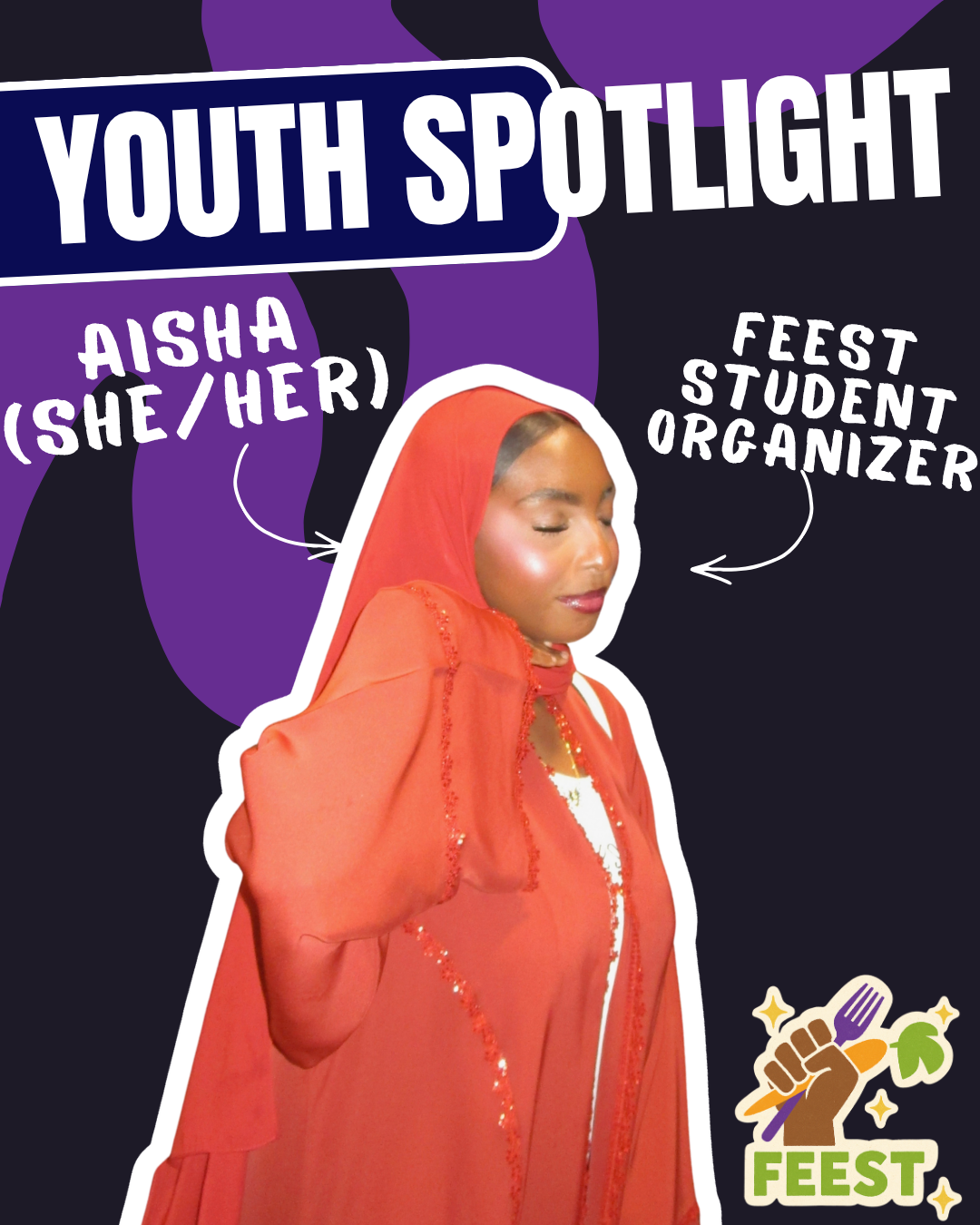
Dev: Thanks for joining me! To start, can you share your name, pronouns, grade, and a fun fact about yourself?
Aisha: My name is Aisha. I’m going into my sophomore year, and my pronouns are she/her. This is my first year at FEEST, so I’m just getting started. A fun fact about me is that my favorite color is purple. I love the color purple.
Dev: Me too! Purple is also one of my favorite colors. What first caught your attention about FEEST?
Aisha: I started seeing the FEEST stands and tables with fruit and snacks, and that caught my attention. I also had a lot of friends at FEEST. They would stay after school for meetings, come back with food, or host events. I would ask them, “What is FEEST? What do you all do?” I was interested and wanted to know more.
They told me FEEST was a nonprofit and basically a student-voice organization, which I love. Personally, I love being involved. I’d rather someone ask me what I want to do and tell me that I have charge of something than have it chosen for me because an adult has more power just because they’re older.
FEEST shows that students are putting in the work. Students are taking charge of what they want to change about their schools, their mental health, the people around them, and their communities. That really stood out to me, and I wanted to be part of it.
Dev: Period. We love a student ready to get involved! What are some of the things you care about changing at school?
Aisha: Honestly, I adore my school. I don’t feel out of place there. I feel like our teachers and adults are really good at making students feel welcome, heard, and comfortable.
But there are some things that I feel only students can really take care of. During FEEST Summer Camp, we talked about working on a wellness corner. We have a space in the counseling office with couches, but it looks like a waiting room. It looks like you’re only there to wait for the counselor.
I feel like an adult wouldn’t know exactly how to organize a space for a student who wants to sit there and calm down. They wouldn’t know exactly what students would feel comfortable with. FEEST gives me the space to work on that with my peers, people my age who have similar ideas.
I also want to join leadership during my sophomore year. I like having a voice, organizing events, and letting people know that I care. I want to be able to do things for other people. That’s what I really care about.
Dev: I can already hear how much you care about your school community. Now that you’ve joined, how would you explain FEEST to somebody who had never heard of it?
Aisha: I would tell them that FEEST is a nonprofit organization that works with students and younger people around my age on mental health and food injustice.
FEEST is focused on making change, but they give you the voice. They give you the ideas and the platform, and they let you take charge of what you want to change and what you want to do differently for the people around you.
Dev: That’s beautifully said. Let’s talk about Summer Camp. What made you keep coming back?
Aisha: I was actually really nervous and scared. I say that I want to help people and make change, but I’m scared to talk to new people. I get nervous because I don’t know how the conversation will turn out.
At Summer Camp, I had some familiar faces, including people from different schools, but everyone was so welcoming. The coordinators, the adults, the people my age, and the other students were all welcoming. It was also really diverse. Nobody was exactly the same.
At school, you might get put in a circle for a project, and it gets awkward. Nobody wants to do anything. But at Summer Camp, I sat at a table with people I had never spoken to before. We had a poster and a pencil, and the next thing you know, we had a full poster! Then we were standing in front of people with a microphone, which is something I thought I would never do.
But I did it.
That’s why I kept coming back every day. I felt like I could be myself. I could put my ideas out there, and people could add to them and make them into something beautiful. I felt proud of my work, and I felt proud of myself.
Dev: You should be proud of yourself! You believed in yourself even when it felt scary. When you think about mental health and feeling safe and supported at school, what do you think students need?
Aisha: Thankfully, I don’t feel like I struggle a lot with my mental health. I think I’m a pretty happy person. But you can be happy and still have struggles with mental health.
It could be the littlest thing. It could be your grades, your home, or the environment you’re in. Sometimes people don’t speak up about it. Personally, if I was struggling mentally, I probably wouldn’t go out of my way to talk to somebody. I might not feel comfortable. I might worry that the person wouldn’t hear me out, understand what I was saying, or might make fun of me.
I wouldn’t want somebody to be told, “Just go talk to the counselor,” and then feel like an outsider. I don’t want anybody to feel like they’re not normal, that they’re wrong for feeling how they feel, or that they’re overreacting.
I want mental health support to feel normal. Maybe it’s a wellness corner, an event, a room, a person, or a group. Whatever it is, it should feel like it’s part of everything else. You could express your feelings with other people, or you could sit in a room by yourself and think. I want it to be normal and available for everybody.
Mental health doesn’t always have to be something huge. Maybe you and your teacher are having a misunderstanding about a grade. You don’t have to be depressed to be dealing with something mentally. You don’t have to struggle for a whole week. It could just be something happening in that moment.
Dev: Exactly. Students should be able to use support before they reach a crisis. Shifting to food justice, how do you feel about school food? What do students need and deserve?
Aisha: I’ve been a picky eater my whole life, and I usually don’t eat school lunch. Even my elementary school teachers knew I wouldn’t eat it. That might be a preference, but there are days when I’m actually hungry and want to eat something.
Schools have to balance healthy and fulfilling food while feeding a lot of people, but I also want to enjoy what I’m eating.
At my school, we don’t have vending machines. Sometimes I’ll go through the whole day thirsty or wanting a snack, but I have to wait until lunch. What if I’m hungry after lunch? Thankfully, I can bring a bottle of water or a snack from home. But some people can’t.
Some families’ grocery budgets only cover the main things they need. They might not be able to add fruit snacks, a granola bar, or a bag of chips. We go to school five days a week and spend most of our day there. Maybe teachers could have a few snacks and drinks in their classrooms. Maybe we could open our student store during the school day instead of only during games.
I would volunteer. I would work there. I just want options. Maybe I’m not thirsty today, but tomorrow I will be. Maybe I don’t want a snack today, but I wanted one yesterday. I want adults to understand where students are coming from and help us make something work.
Dev: Opening the student store seems like a very reasonable place to start. I also heard someone mention the culinary program at your school, so there could be something there as well!
Aisha: We have a culinary class, but that class has struggled too. There were problems with staffing and teachers being on leave. There have also been budget cuts and layoffs.
The culinary class had a card with a limited amount of money for food. At first, you learn the basics of cooking. But eventually, it’s time to actually cook. You can’t cook without ingredients. If there isn’t money for ingredients or a teacher in charge of the budget, what are students supposed to do?
Students can end up sitting there all year without cooking or learning what they signed up to learn. That’s where justice comes to mind. Why do we have a whole class where we’re supposed to learn about food and cooking, but there isn’t money to buy the ingredients?
There are so many levels to it. Some of those things are out of my control. I can’t control what the district or government does with its money. But I feel like this is where FEEST can help. I’m a student who wants to learn, but I’m also thinking, “How can I help fix this? How can I learn, share education, and help the people around me?”
Dev: That is a whole power analysis right there! Well said, Aisha. Let’s move into your dreams for the future. What are you imagining for your life after high school?
Aisha: I have so much that I think about, so much that I want to accomplish, and so much that I want to do. I don’t know how to put a pin on exactly one thing.
My mom has a daycare, and I help her a lot with the kids. I’ve never seen myself as somebody who wants to work with kids, but I also don’t want to let go of that experience. Maybe I could help kids in another way, like helping children who don’t have access to books or who need support learning to read.
I’ve wanted to be an engineer since I was in second grade. As I’ve gotten older, I’ve also started thinking about becoming an entrepreneur or studying business management. There is so much I want to do that I don’t know which major could hold all of it.
As a Somali Muslim girl, there are things people think I can’t do. People might make assumptions because I’m Muslim, because I wear hijab, because I’m Somali, or because I have immigrant parents. My parents and siblings weren’t born here. I’m the only girl in my house who was born in America, and I have the opportunity to take my education further and do something different for my mom, my uncles, my nephews, and my nieces.
I want to graduate high school as a Running Start student. I want a million cords around my neck. I want every medal. I want to be valedictorian. I want to go to college, graduate from a university, and get my doctorate. I want every diploma.
When I finish all of that, I want to be proud of myself, and I want the people around me to be proud of me. I want to do something that brings together all of my dreams, the people before me, the people after me, and the people who come after them.
Someday, I want to marry and have a happy family. I want my kids to follow in my footsteps, or maybe do something completely different. I want my kids and the people around me to feel like they don’t have to be ashamed of who they are.
I’m going to have Somali kids. I’m going to have kids who wear hijab. I’m going to have boys who wear khamiis on Fridays to go pray. People might call it a dress, but it’s cultural and religious clothing.
I want my kids and the people around them to feel proud of who they are and feel like they can move through the world without being ashamed of their culture or religion.
That’s why I joined FEEST. That’s why I want to join other programs and organizations that help me become who I want to be while making a difference for everybody around me.
Dev: You said you weren’t sure what you wanted to do, and then listed enough dreams for several lifetimes. The beautiful part is that you can keep exploring and changing your mind along the way. What motivates you to keep doing so much?
Aisha: I want to be a daughter who makes everyone smile. I want everyone to be proud of me, but I also want to look back and know that I didn’t sit around doing nothing.
I could just go to school and come home. But why would I do only that when I know I can do so much more if I want to? If I put my heart into it, I can do it.
People around me can do it too. Whether you struggle or not, and whether the road is smooth or bumpy, you can do what you want if you put your heart into it. I want everybody to know that.
Dev: Last question. Imagine you have the microphone and can speak directly to the entire FEEST community. What do you want people to hear?
Aisha: I want everybody to know that no matter where you are right now or where you come from, you have the power to become who you want to be and accomplish what you want if you put your heart into it and believe in yourself.
Everybody can tell you that you can’t do something. Nobody else might believe in you. But if you believe in yourself, you can become so many amazing things.
Do what you want to do, whether it makes nobody proud or everybody proud. As long as you’re proud of yourself, feel successful, and are happy with what you did, that’s what matters.
Dev: Mic drop. Thank you, Aisha, for sharing your ideas, your dreams, and your heart with us!
Aisha’s reflections show how quickly belonging can grow into leadership. In one week of Summer Camp, she went from feeling nervous about meeting new people to presenting alongside them with a microphone in her hand. Now, she’s ready to help create spaces where students can rest, access food, share ideas, and be part of decisions that affect them.
Her dreams are expansive, carrying her interests in education, engineering, business, family, culture, faith, and community into one vision for the future. She imagines success as something she can be proud of herself, something that honors the people who came before her, and something that creates more room for the people who come after.
We’re grateful that Aisha has chosen to begin part of that journey with FEEST, we’re proud of her, and we’re excited to see where her energy and heart takes her.
Show FEEST some love!
Youth are in the lead at FEEST because we know that change is not effective unless those most impacted by health inequities are the decision makers. Support youth leadership by donating today, OR sign up for our newsletter to get the latest from FEEST!