
Who Pays the Cost? Cat on Youth Voice and Environmental Justice
Today, we’re featuring Cat (she/her), a senior, Running Start student, and longtime FEEST Student Organizer. Over the past three years, Cat has pushed herself into new leadership opportunities, from emceeing FEEST events to advocating for better food access at school.
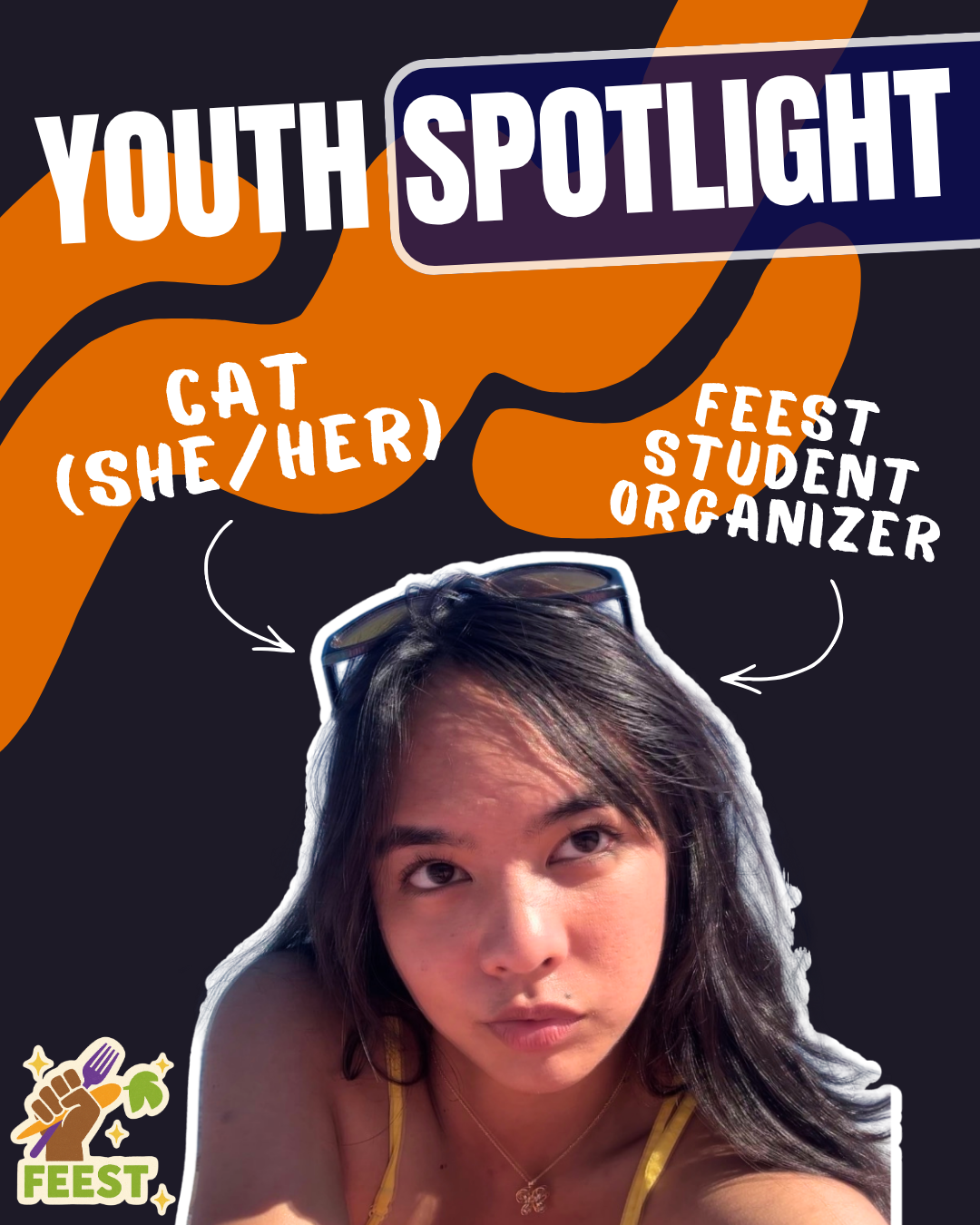
Outside of FEEST, she is also a dancer, and a research assistant with Eco Filipino, where she researches environmental issues affecting the Philippines. In our conversation, Cat shared what she has been learning about AI data centers and Pax Silica, reflected on the differences between high school and college as a Running Start student, and told us about her dream of working in medicine.
Dev: Thanks so much for taking the time to chat with me! To start us off, can you share your name, pronouns, what grade you’re in, and a fun fact about yourself?
Cat: My name is Cat, my pronouns are she/her, and I’m in my senior year. I’ve been with FEEST for about three years now, which is quite long! A fun fact about me is that I’m part of a dance team, and I’ve been dancing for about three or four years.
Dev: Three years is a long time! Now I have to ask, what is your favorite style of dance?
Cat: Definitely hip-hop. I think that’s my favorite. I also really like house. I did a workshop, and it was really fun.
Dev: Shoutout to the dancers! Let’s talk about how your FEEST story started. What first made you want to join?
Cat: My sister introduced me to it. She went to my school and told me, “There’s this program where you can get paid, work with FEEST, and help feed the community.”
Then I saw FEEST tabling during lunch, and that was where I signed up. Applications weren’t even open yet, but I was really interested in joining.
Dev: Shoutout to sisters bringing sisters into the work! Besides the food and getting paid, what made you excited about FEEST?
Cat: I was honestly really interested in social justice. I had been introduced to it through a class, and through FEEST, I was able to expand on it and learn that this was something I really wanted to do and was passionate about.
Through FEEST, I also started doing programs outside of it. I did a six-month internship with Powerful Voices, where I was able to make art about things happening in the world. One of the issues I focused on was gun violence. I got to talk about it in front of a whole group of people and showcase my art, which was really awesome.
Dev: That is awesome. You mentioned being interested in other social justice issues too, especially environmental justice. Can you share more about that?
Cat: Definitely environmental justice. I’m a research assistant with Ecophilipino, where we spread awareness about environmental issues happening in the Philippines. I do the research portion, so I’ve been learning about different things happening there, especially around AI data centers and Pax Silica.
Dev: I don’t know much about this. What have you been learning about AI data centers and Pax Silica?
Cat: I started learning more about data centers and especially about their water systems. They use so much water, and there are limits to how much that water can keep being reused because things build up in it over time.
That concerns me because they’re trying to implement these AI centers in the Philippines, where there are already communities that lack access to safe water. I lived in the Philippines for a really long time, and we couldn’t just drink fresh water straight from the faucet.
So when you’re putting something that needs so much water in a place where people already lack that resource, I start thinking about what the cost is going to be.
Dev: That’s a huge question. And you also mentioned Pax Silica specifically. Can you explain what that is and why it connects to what you’re researching?
Cat: Pax Silica is an initiative started by the U.S, that the Philippines is partnering in, along with other countries.
Part of what I’ve been learning about is how the Philippines has minerals, like nickel and other resources, that are useful for technology and AI. So people in the Philippines are asking what this actually means. Is it really going to be an opportunity for people there, and what are we giving up for it?
There’s also so much land involved. There are farmers and Indigenous people in some of these areas, and one of the things I’ve been learning about is people being removed from their land.
When I first started doing this research, some of these plans weren’t as far along, but now they’re actively developing them. Hearing about Indigenous people potentially losing access to their land is really horrible.
Dev: You just taught me something because I hadn’t heard about Pax Silica before this conversation. What I’m hearing from you is a really important question: who actually carries the environmental and human cost of building this technology?
Cat: Yeah. There are so many different things I’ve been learning about it. I wish I could explain all of it better because there’s a lot of information, but those are some of the things that have really stood out to me.
Dev: I think you explained it well! You definitely taught me something, and I appreciate you sharing what you’ve been researching. Let’s bring the conversation back to school. What is something you care about changing in your school community?
Cat: I didn’t really have an answer to this question for the longest time because I didn’t know what I would want to change. But I would really like to be part of creating a food pantry at school.
As a full-time Running Start student, I’m usually away from my high school during lunch, but I still have after-school activities there. When I get to school, I’m really hungry, and I don’t always have money to buy food or snacks.
A food pantry would be something I could help organize and also benefit from, because I understand what it’s like to not have food and still have to do sports activities while hungry.
Dev: That makes so much sense. Students need food after school too, especially when they’re staying for sports, clubs, meetings, or other activities. How could FEEST help students work toward creating something like a food pantry?
Cat: FEEST could help us talk to the administration and connect us with resources. There’s also the question of funding, where the food would come from, and how we could get culturally relevant food into the pantry.
I heard that one of our school administrators is interested in having a food pantry and understands how one could work. FEEST could help us research and talk to the people we need to talk to.
Dev: That’s smart. Having someone on the administration side who is already interested gives students a strong place to begin organizing.
If one of your friends asked, “What is FEEST?” or why they should join, what would you tell them?
Cat: I would probably kind of bribe them by telling them we get really good food first.
But I would also tell them that if they’re interested in social justice and making changes in their school, that’s what FEEST is about. I’ve invited one of my friends to meetings before, and she has participated off and on. I would encourage people to try joining.
Dev: I love that so much! Can you share a FEEST moment that made you feel proud?
Cat: One funny one was when I co-emceed First We FEEST. That was really new for me.
I try to push myself into public speaking, leadership, or emcee positions because I know that’s an area where I need more practice. Public speaking doesn’t come naturally to me.
But putting yourself in those situations really helps you improve as a person and improve your skills. There are still things I want to work on, but those experiences have really helped me.
Dev: And you did such a great job emceeing! I’m glad you’re proud of yourself for that. I love that you’re intentionally putting yourself in situations where you can practice something that doesn’t necessarily come naturally to you.
Let’s talk about mental health. When you imagine a school where students feel supported, safe, and well, what do you think students need?
Cat: I think we need a Wellness Room at my school.
Right now, you can’t go into the counseling area unless you have an appointment, which is also stupid. Sometimes adults are worried that students are just trying to get out of class, but that removes opportunities for students who are actually seeking help or need somewhere to go when their mental health is being affected.
Dev: What you’re saying makes sense. Students should be able to have somewhere to rest or seek support. You have a pretty unique perspective as a full-time Running Start student because you’re moving between high school and a college campus. What differences have you noticed?
Cat: There are a lot of differences because you have much more freedom in college. You’re able to leave class and walk around. You’re treated more like an adult.
The college also promotes mental health support more. I’ve seen posters and information about people you can talk to.
When I go back to my high school and see how students are treated, I could never go back to being a full-time high school student. I love my freedom too much.
Dev: Running Start gives you a really interesting perspective because you’re being trusted and treated as an adult in one part of your life, and then you can compare that directly with how students are treated at high school.
Let’s talk about food justice. When you think about school food, what do you think students deserve?
Cat: As someone who immigrated to America and has seen food systems in other places, I don’t understand why America has to keep providing food like this.
We get chicken nuggets or awful pizza. When you see cafeterias in places like Korea or Malaysia, they have more nutritious and culturally centered food for students.
I always wonder why America can’t do the same. I believe they have the funding and the ability to give students more natural, better-tasting food.
Dev: Well said Cat, I agree, students deserve meals they can actually enjoy eating!
Last big question, what are you excited about for your future?
Cat: I really want to go into the medical field. I’m already a certified CNA, and I’m hoping to go into nursing and later attend physician assistant school.
Becoming a physician assistant is actually my dream, particularly working in dermatology.
I’ve never admitted this to my sister, but part of why I want to go into dermatology is because she struggled with hormonal acne throughout her life. I want to be able to support and help people like her.
Dev: I love that. That’s such a caring reason to choose the field you’re interested in.
One final question. You have the microphone to speak directly to our community. What do you want people to know?
Cat: I want to shout out Eco Filipino! I’m the research manager with the group, and we’re currently sharing information about environmental issues affecting the Philippines, including the impact of AI data centers. I hope people will follow Eco Filipino and keep up with the research and organizing we’re doing.
Dev: Shoutout to Eco Filipino! And thank you, Cat, for sharing so much with me. I genuinely learned something from you today, and I’m grateful we got the chance to talk about everything from food justice and public speaking to AI data centers and your dreams for the future!
Cat’s story shows leadership taking shape through curiosity, practice, and care. Over three years with FEEST, she has continued challenging herself to speak publicly, organize alongside other students, and think critically about the systems affecting her communities – near and far.
Her questions travel far beyond one school building. Who has access to food? Who is trusted to make decisions? Who has somewhere to go when they need support? And as new technologies expand, who benefits and who is asked to carry the cost?
Whether Cat is researching environmental justice, imagining better access to food at school, stepping up to a microphone, or preparing for a future caring for patients, she is continuing to ask those questions and figure out how she wants to be part of the answer.
We’re grateful for Cat’s years of leadership at FEEST, and excited to see where her curiosity, compassion, and willingness to keep challenging herself take her next.
Show FEEST some love!
Youth are in the lead at FEEST because we know that change is not effective unless those most impacted by health inequities are the decision makers. Support youth leadership by donating today, OR sign up for our newsletter to get the latest from FEEST!